PRESS
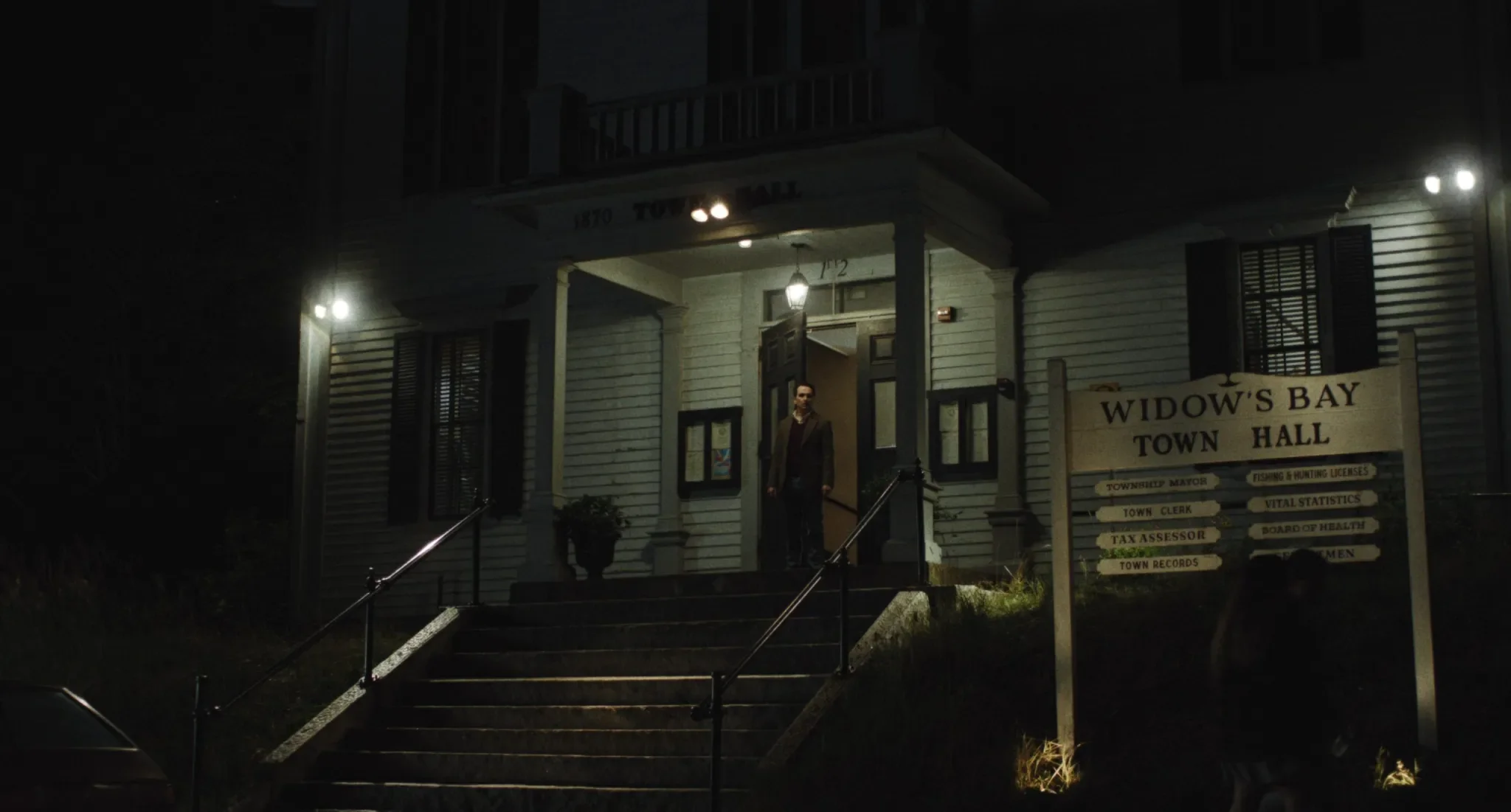
‘Widow’s Bay’: Designing the Bay
Production designer Steve Arnold knows his way around a creepy New England setting — previous credits for the four-time Emmy nominee include Midnight Mass and Castle Rock, shows set in the region.
But for Widow’s Bay, he had an entirely new challenge.
“I wanted to keep it looking as remote and arcane as this island was supposed to be,” he says of the haunted island town that gives the show its title. No small task: As revealed in season one of the Apple comedy, the origin of Widow’s Bay dates back to the 17th century. “There were no people here when they arrived; they had to build everything from scratch during what is still believed to be the harshest winter in Widow’s Bay history,” Arnold says.
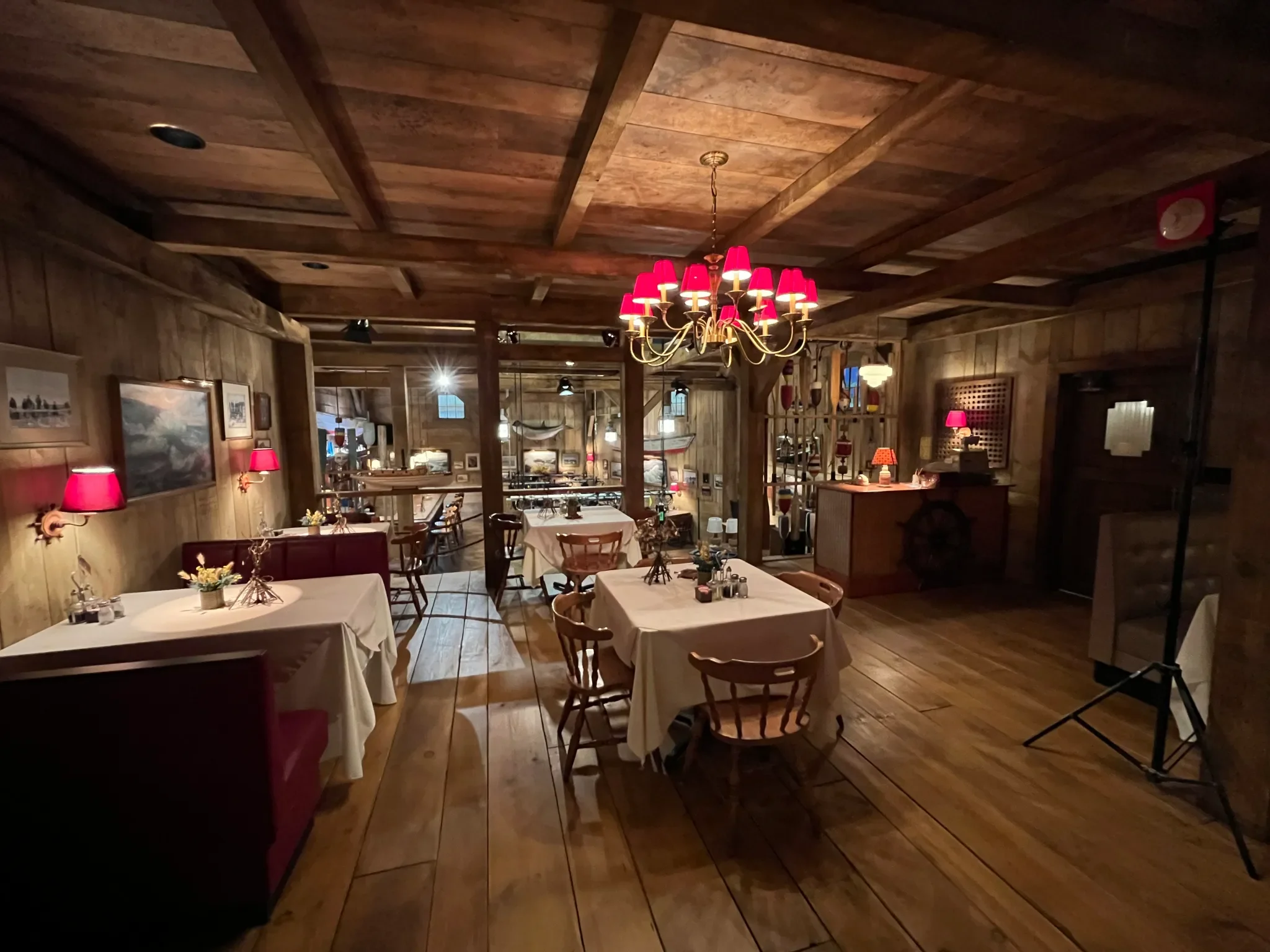
From Board Games To Boats — Find Out How ‘Widow’s Bay’ Was Built
Set against the remote, insular world of its titular island, production designer Steve Arnold and set decorator Jennifer Engel created a lived-in, slightly stuck in time and, when necessary, deeply unsettling environment. Arnold and Engel had to build a visual language that could accommodate the series’ peculiar blend of horror and comedy without tipping too far in either direction. That meant creating spaces that could feel warm and inviting one moment and ominous the next, from the inn’s welcoming parlor infused with haunted crawl spaces to the nautically-themed The Salty Whale restaurant and the period-accurate environments of the colonial-era town in Episode 6’s “Our History”.
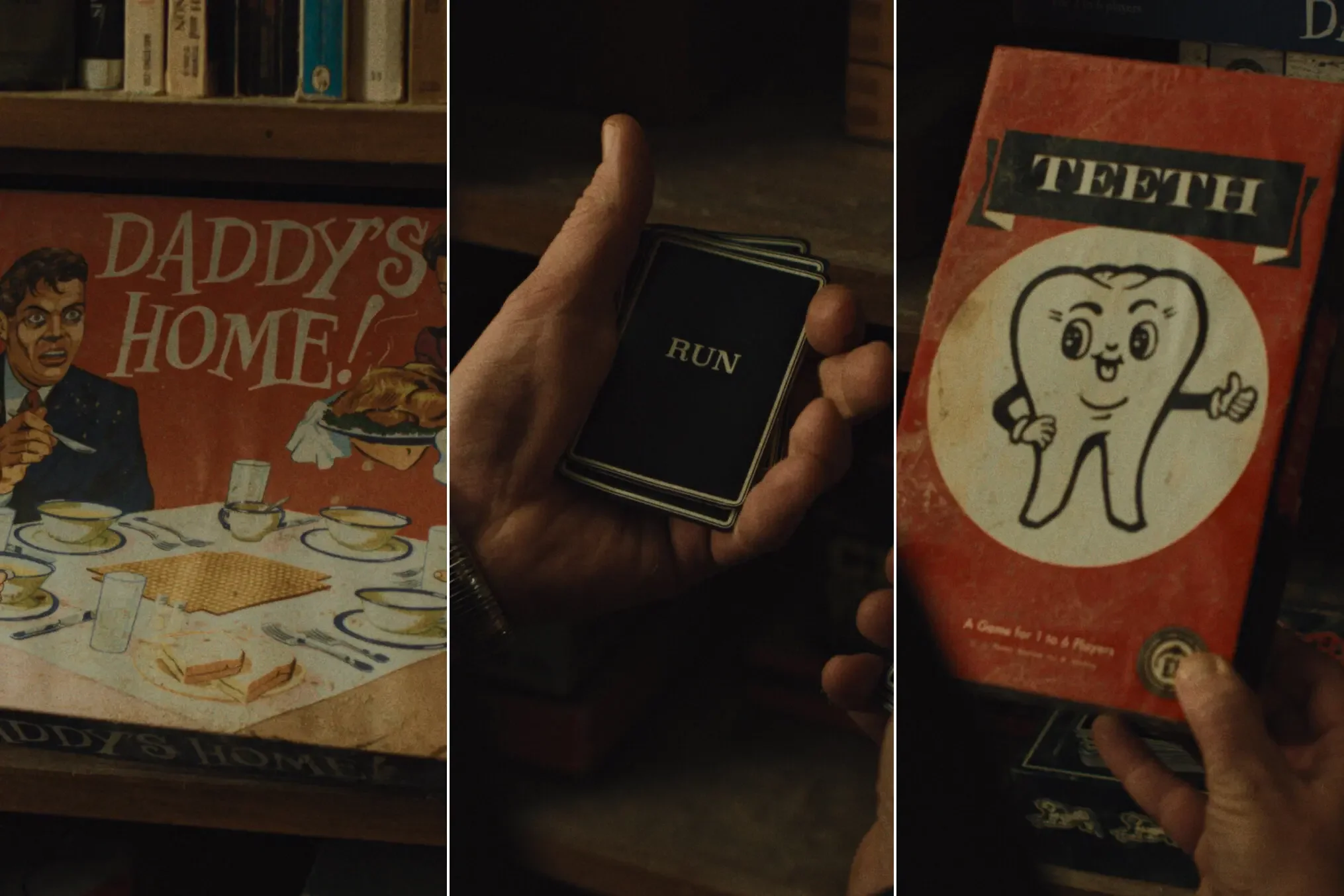
What’s Up With Those Creepy Board Games in ‘Widow’s Bay’?
“Steve Arnold, the series production designer and an art department veteran of over 40 years, said that part of what made the games so haunting was that they invoked our nostalgia for physical media with “the interactiveness of throwing dice and doing all those things, spinner and all of that.” He added that many of these analog game devices were about creating the element of surprise — a natural fit for the horror genre. The RUN deck, for instance, has “turnover cards,” which analog board games may use to announce plot twists to the players and, accordingly, to indicate where to move on the board. “I think that is one of the more important parts of it, in terms of taking you back,” Mr. Arnold said. “This place is really dated, and it’s really a remote area that is caught in time.” - Sam Corbin
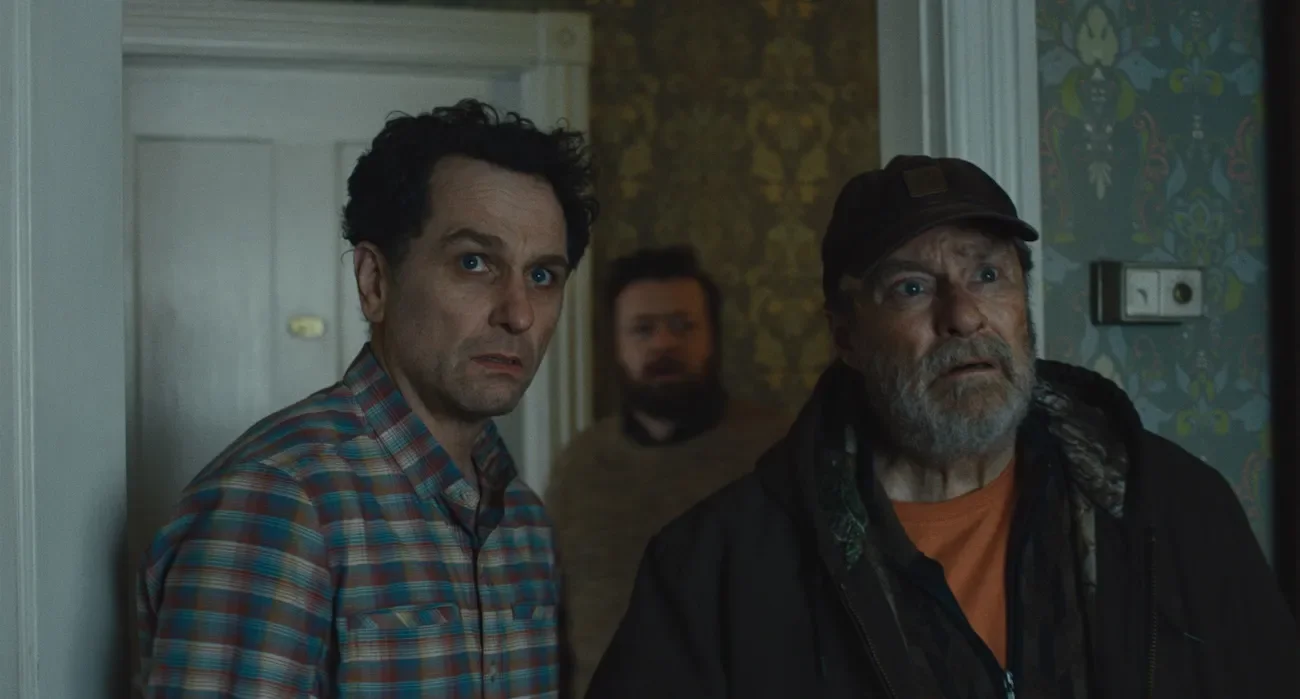
‘Widow’s Bay’ Review: Matthew Rhys’ Inspired Island-Bound Horror-Comedy Is a Wicked Treat
“As soon as the series confirms the haunt is real (and spook-tacular), it kicks off a stellar run of episodes that expand the town lore and sharpen its characters in rapid, imaginative succession. Patricia (Kate O’Flynn), a well-meaning outcast desperate to improve her social standing despite being shunned by the popular kids since high school, earns her spotlight in a diabolical departure episode about throwing a party no one asked for. Flashbacks are deployed as more than mere framing devices, since the past plays an active, exciting role in the town’s present, and there’s an extended drug trip that skillfully manipulates lapsed time through recurring blackouts to keep you on the edge of your seat. Throughout the detailed narrative that rewards close scrutiny (Steve Arnold’s production design is a constant treat all by itself), the cast thrives.” - Ben Travers
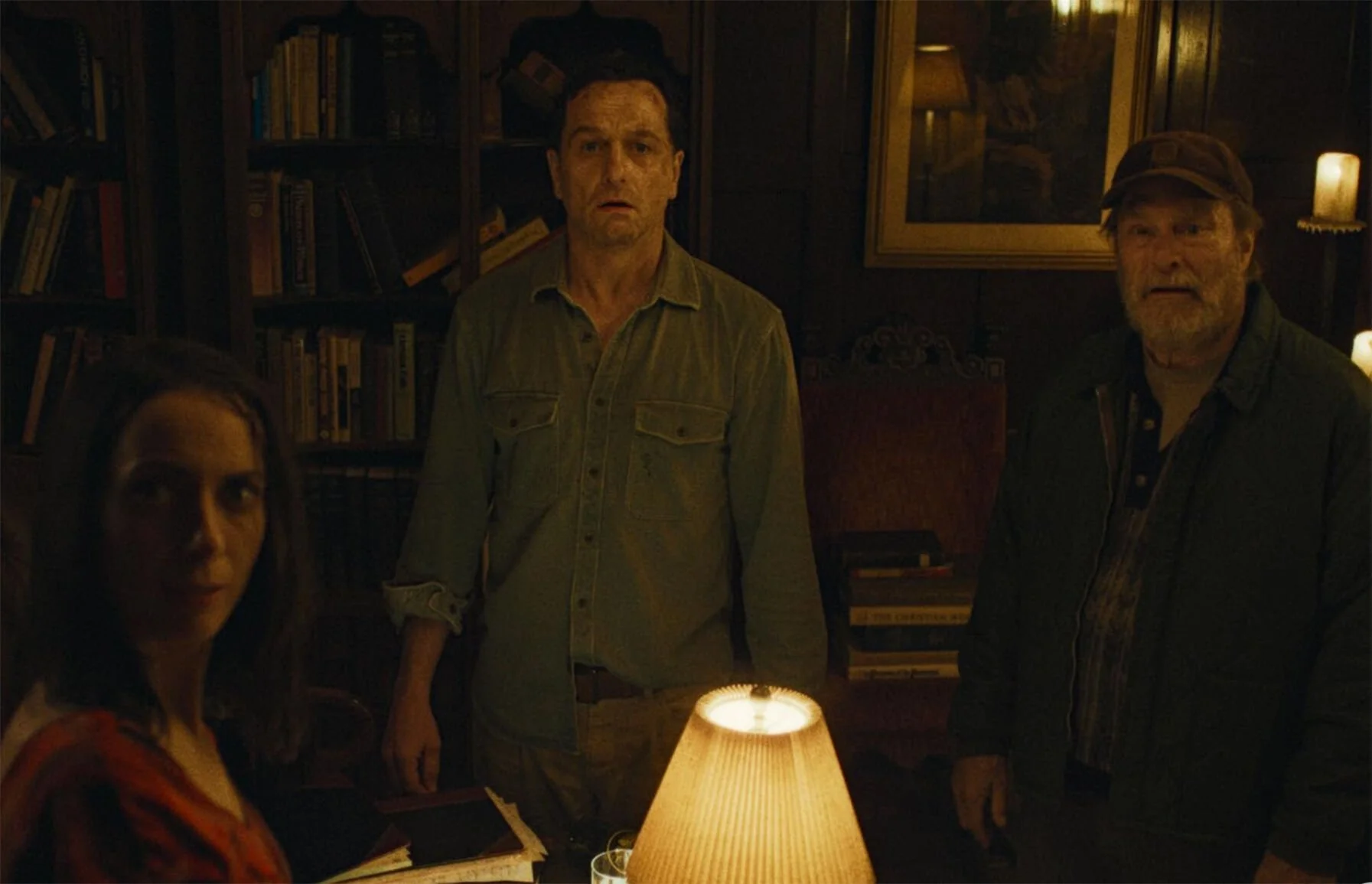
Crafting haunted seaside haven of ‘Widow’s Bay’ with Steve Arnold, Jennifer Engel
For a series where the setting is as much a character as its residents, building the world of “Widow’s Bay” was no small undertaking. Yet for Arnold, one of the show’s defining elements came surprisingly naturally: capturing the isolation and intimacy of island life.
“I think I have a fairly intimate knowledge of island living … I’m on an island right now,” Arnold said. “Four generations of my family have been on this island — not quite as remote as ‘Widow’s Bay,’ but it is an island in Puget Sound. So I kind of have a feel for island living and remoteness.” - Mighty Behrendt
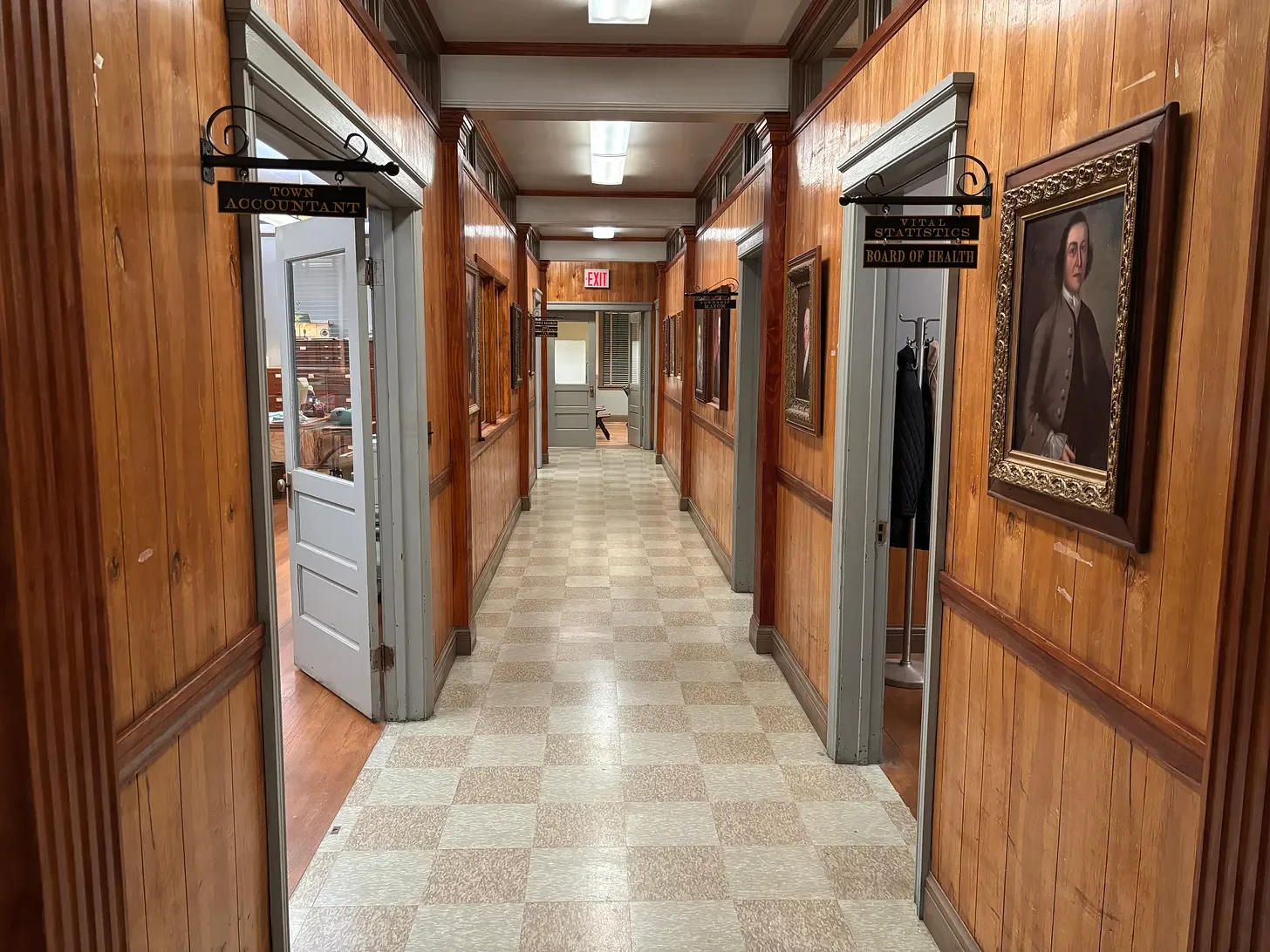
Give 'Em Hell, Steve
“The series’ spatial strength exists in large part due to the award winning production designer Steve Arnold, whose credits include House of Cards and (the great) Mindhunter. It’s so pitch-perfect—with a tone best described as thorough yet not overly serious—that Arnold now has a fresh Emmy nomination (his fourth). (Widow’s Bay has a total of 19 Emmy noms, and this interview occurred before they were announced—I feel very lucky to have gotten some of Steve’s time!)
Many of Widow’s Bay’s scenes are highly memorable (Patricia’s occult punch party, Rosemary’s unhinged but deeply amusing genealogy sequence), and they’re made all the more so by the dingy rooms and dark roads across which they transpire: Arnold and co. built this freaky little world. “ - Nick Remsen
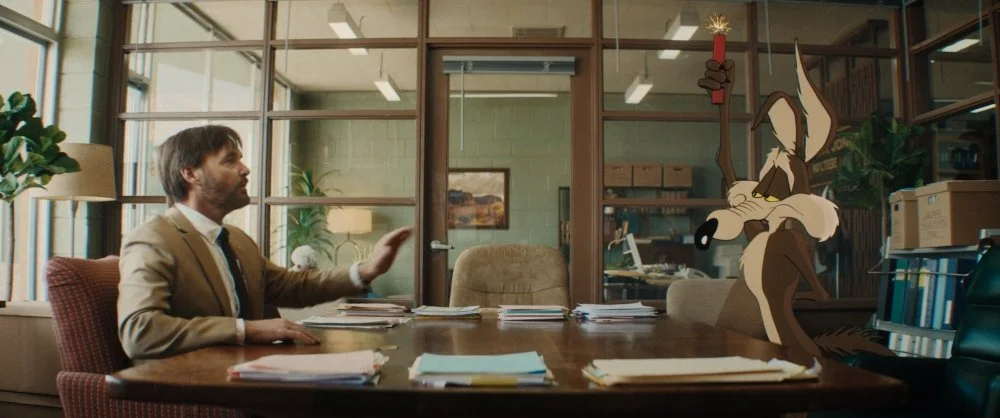
‘Coyote vs. Acme’ Director Dave Green Discusses the Making of the Long-Awaited Movie
“Tone was one of my biggest buy-ins, and I was aware of the Ian Frazier New Yorker article called Coyote v. Acme, which is about Wile E. Coyote suing Acme,” Green explains. “That piece, which was heavily satirical, super smart, dry, funny and straightforward, was something that I was hugely drawn to. I felt like the article was laugh-out-loud funny, and I wondered how we could honor that same straight-faced approach in the movie version. The gold standard to me in hybrid animation is Who Framed Roger Rabbit. One of the things that makes Roger Rabbit work so well is that balance of stupid and smart, that total mixture of darkness and brightness. The cartoon reality mashed up with the noir universe of that movie was hugely inspirational.” - Jeff Spry
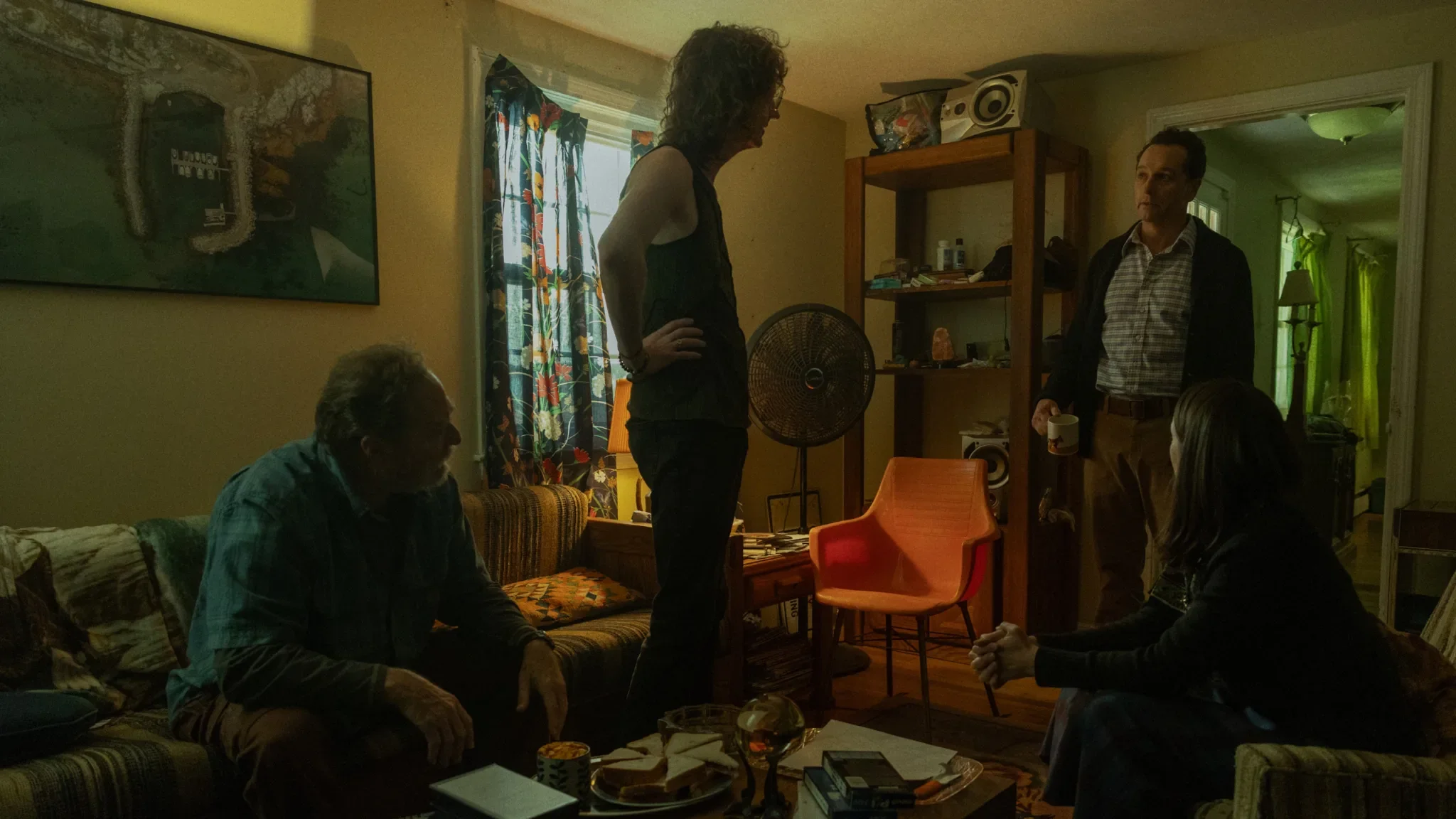
‘Widow’s Bay’ Review: A Perfect Mix of Horror and Comedy
“The horror in particular is helped by the atmosphere of Widow’s Baycrafted by Hiro Murai’s brilliant direction and Steve Arnold’s wonderful production design is such a treat. The island they’ve created for the show feels real which is a testament to what they, and all the other technical crew have built with what feels like a sizeable budget from Apple.” - Vishu Lakkamraju

‘Mindhunter’: Expanding the Visual Aesthetic for Season 2 with Erik Messerschmidt
“There’s a lot more world building in Season 2, with production designer Steve Arnold’s Atlanta Task Force headquarters serving as the set piece. ‘The real task force was a converted car dealership very similar to the set Steve built on stage,’ Messerschmidt added. ‘He wanted to paint the windows to obscure the view from outside just as the [Atlanta Police Department] had done during the real investigation. At first, I was worried about this, but when he first showed me the paint samples he had picked, I immediately fell in love with the way the light looked through the painted windows.” - Bill Desowitz 2020
Architectural Digest: 11 TV Shows to Binge for Design Inspiration
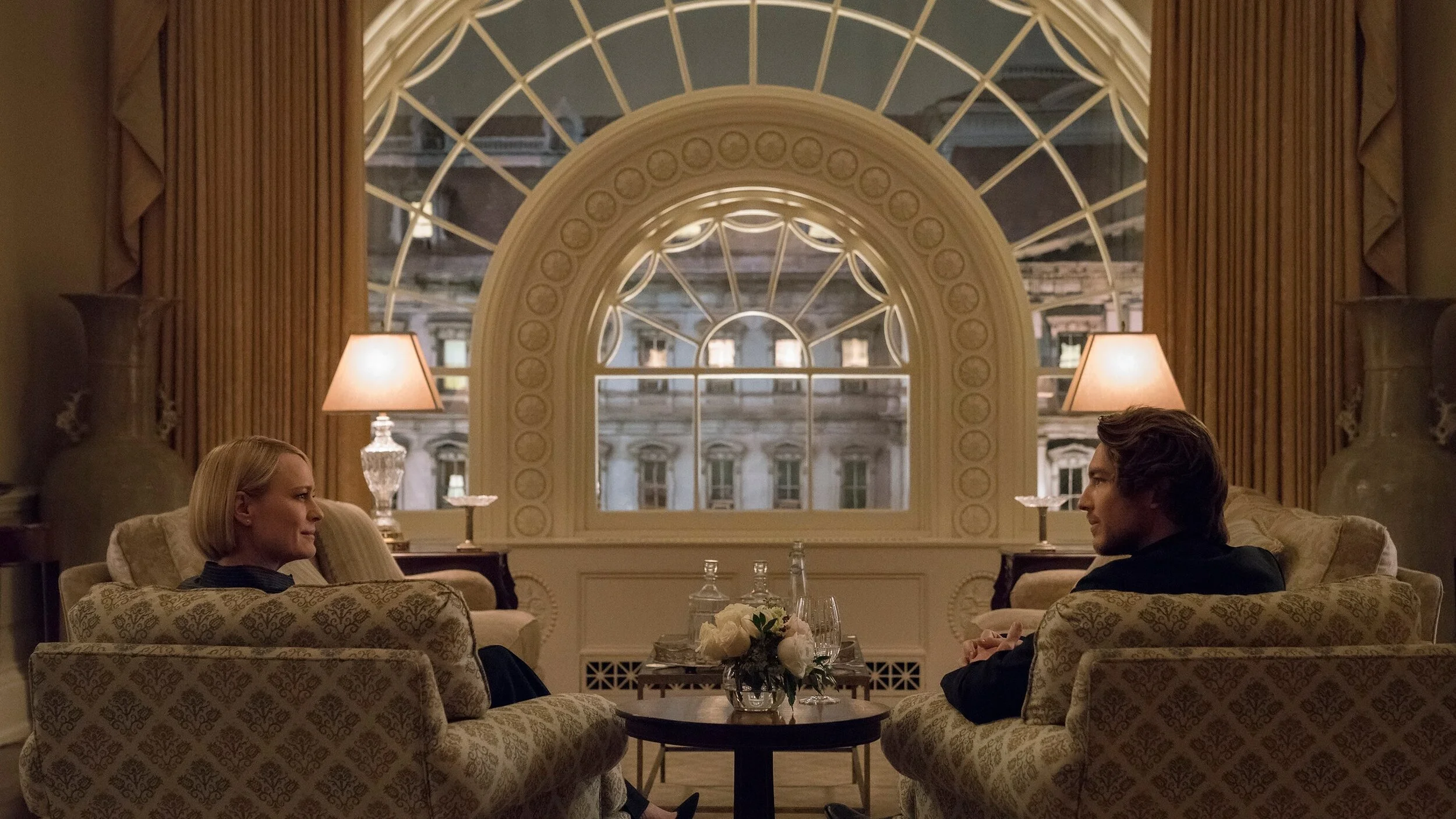
Production designer Steve Arnold and his team constructed the clutter-free White House private residence on a soundstage and sourced furniture from both eBay and estate sales in New York and Washington, D.C. (Note that Frank’s desk is actually from Kittinger, the company that has furnished the White House since Nixon was in office.) The couple’s Georgetown abode was patterned after a traditional townhouse with interiors based on Victorian architecture.” - Mara Reinstein 2020

Mindhunter Season 2: Interview with DP Erik Messerschmidt
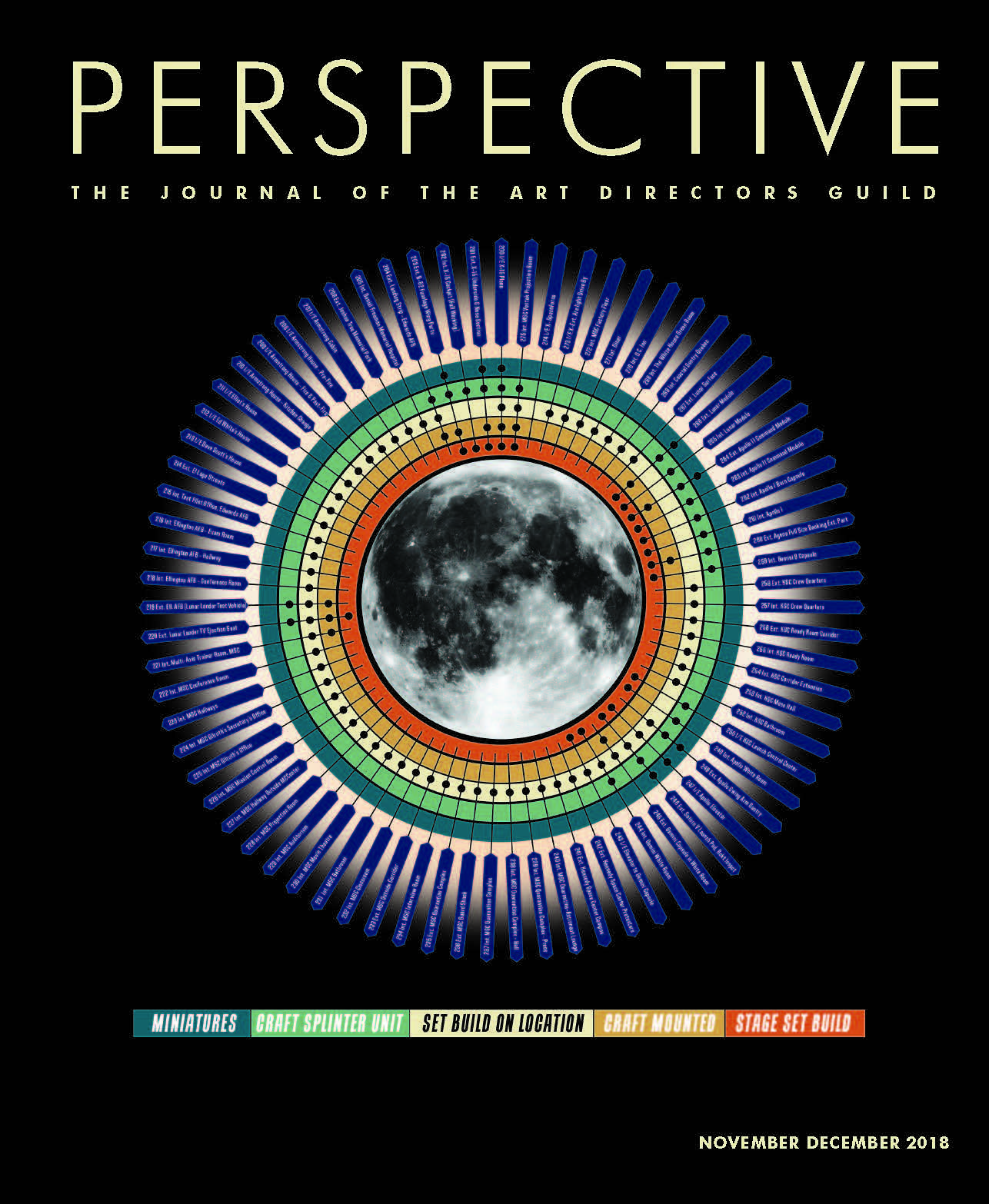
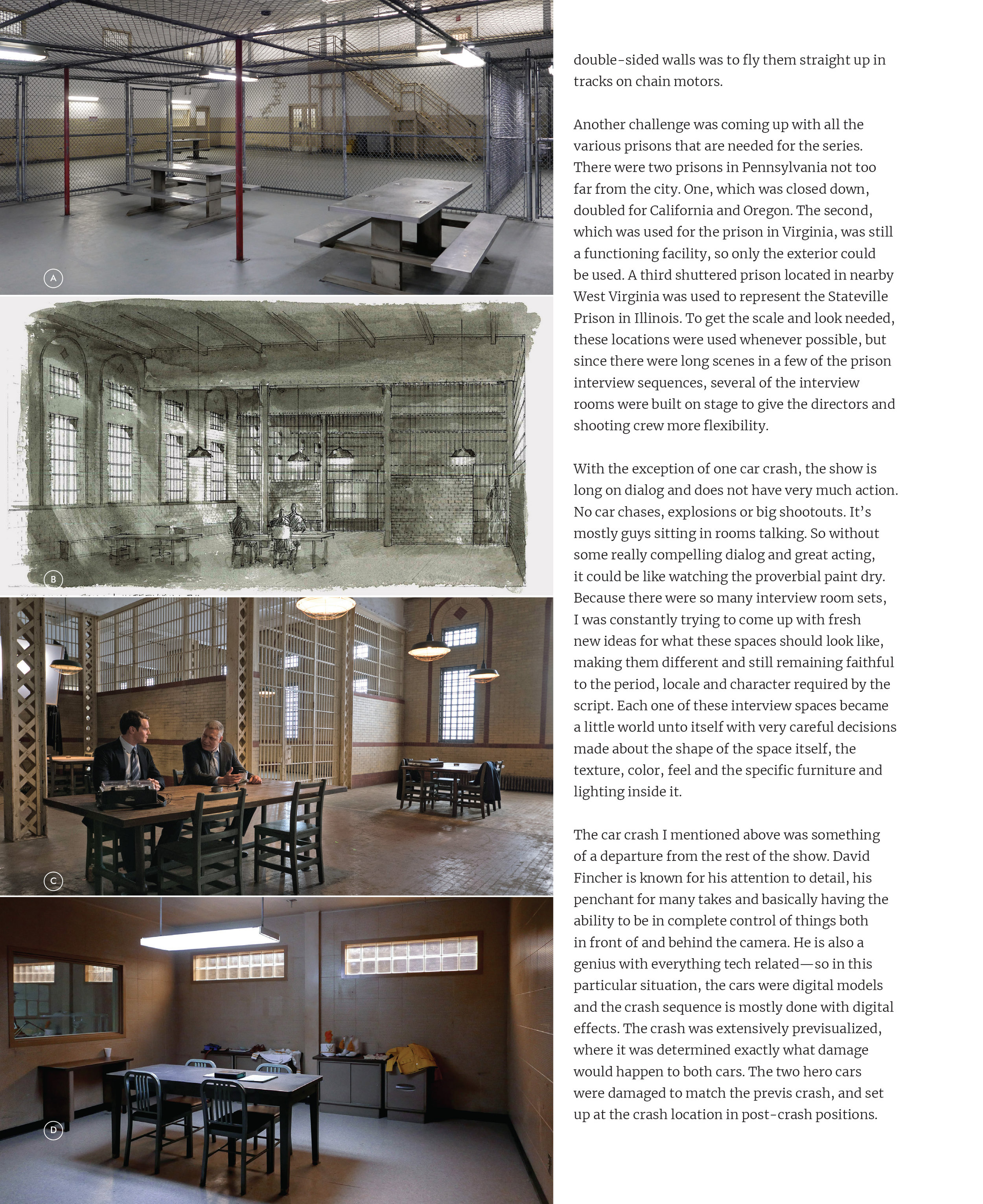
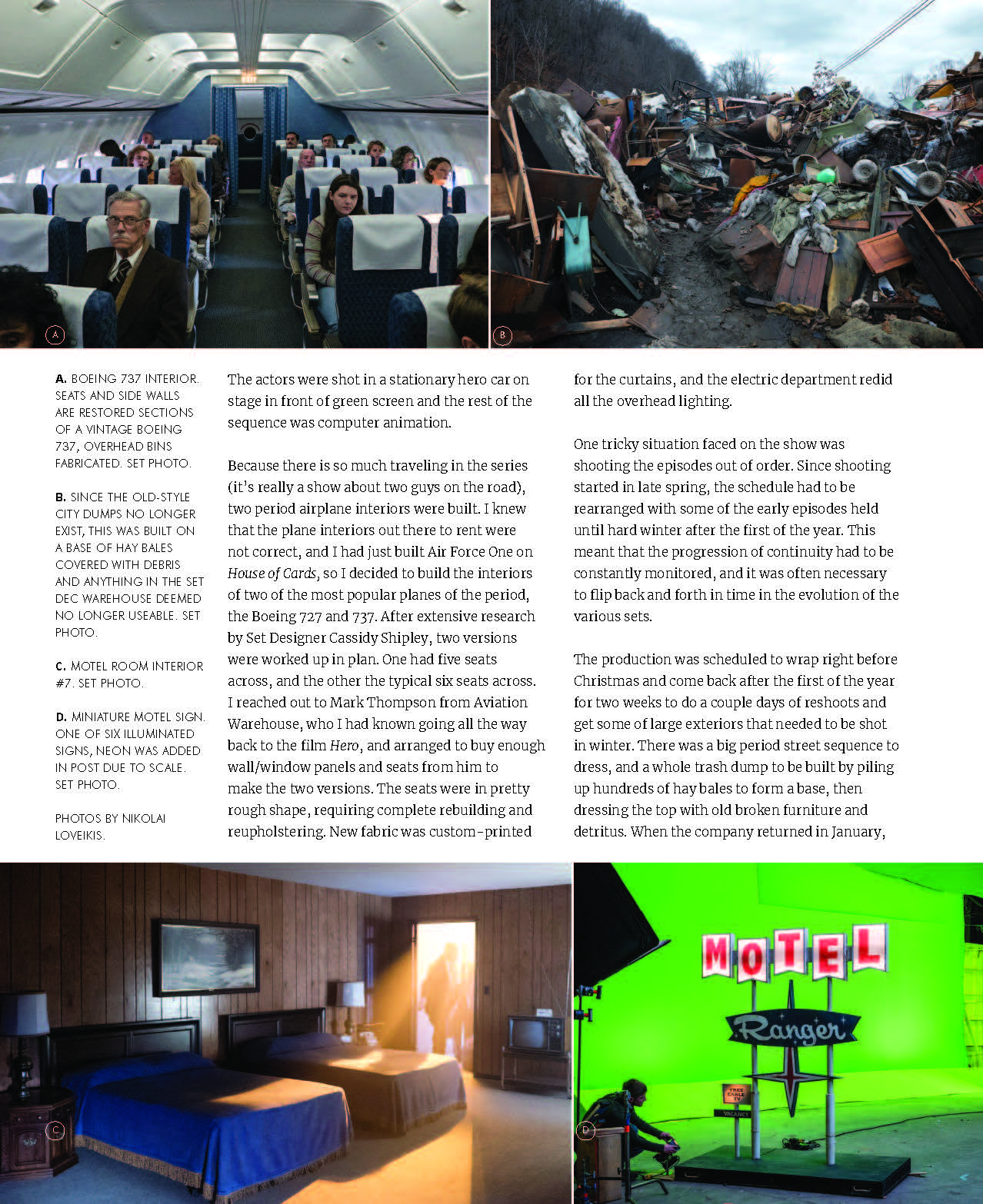
“For Berkowitz we wanted the room to feel cool and uninviting. Steve Arnold built a beautiful set where the table is surrounded by a giant cage. It gave us great composition opportunities…David and Steve Arnold thought it would be interesting if Holden and Tench interviewed Manson in the prison infirmary…Steve Arnold built a beautiful set on stage that was modeled after the real task force headquarters (the Atlanta Police Department) set up inside an old car dealership. The set had two-story glass windows, which Steve painted with an eggnog-colored white latex paint.” - Matt Mulcahey 2019

“Time Hunters” - EMMY Interview with Mindhunter Season 1 Creative Team
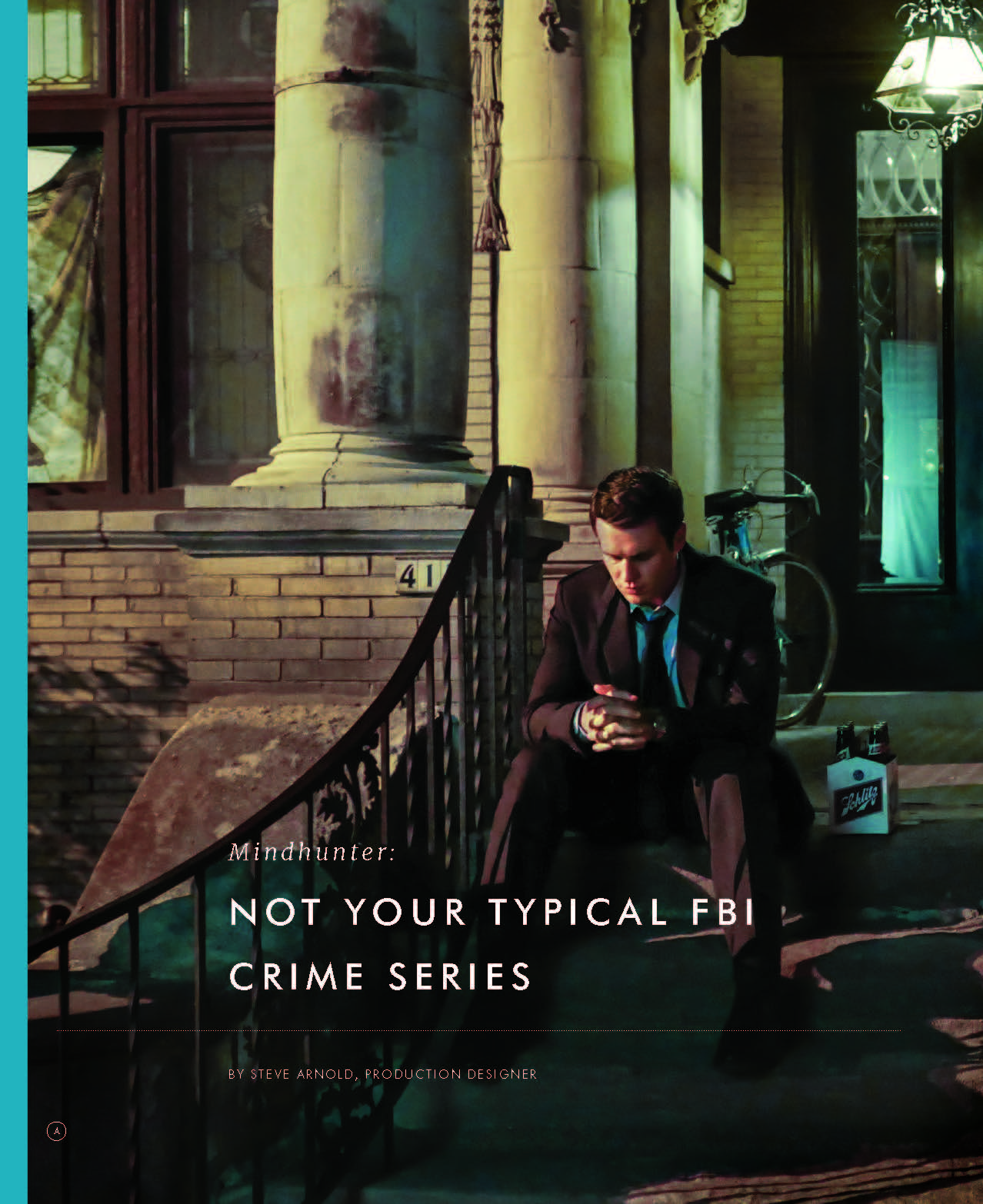
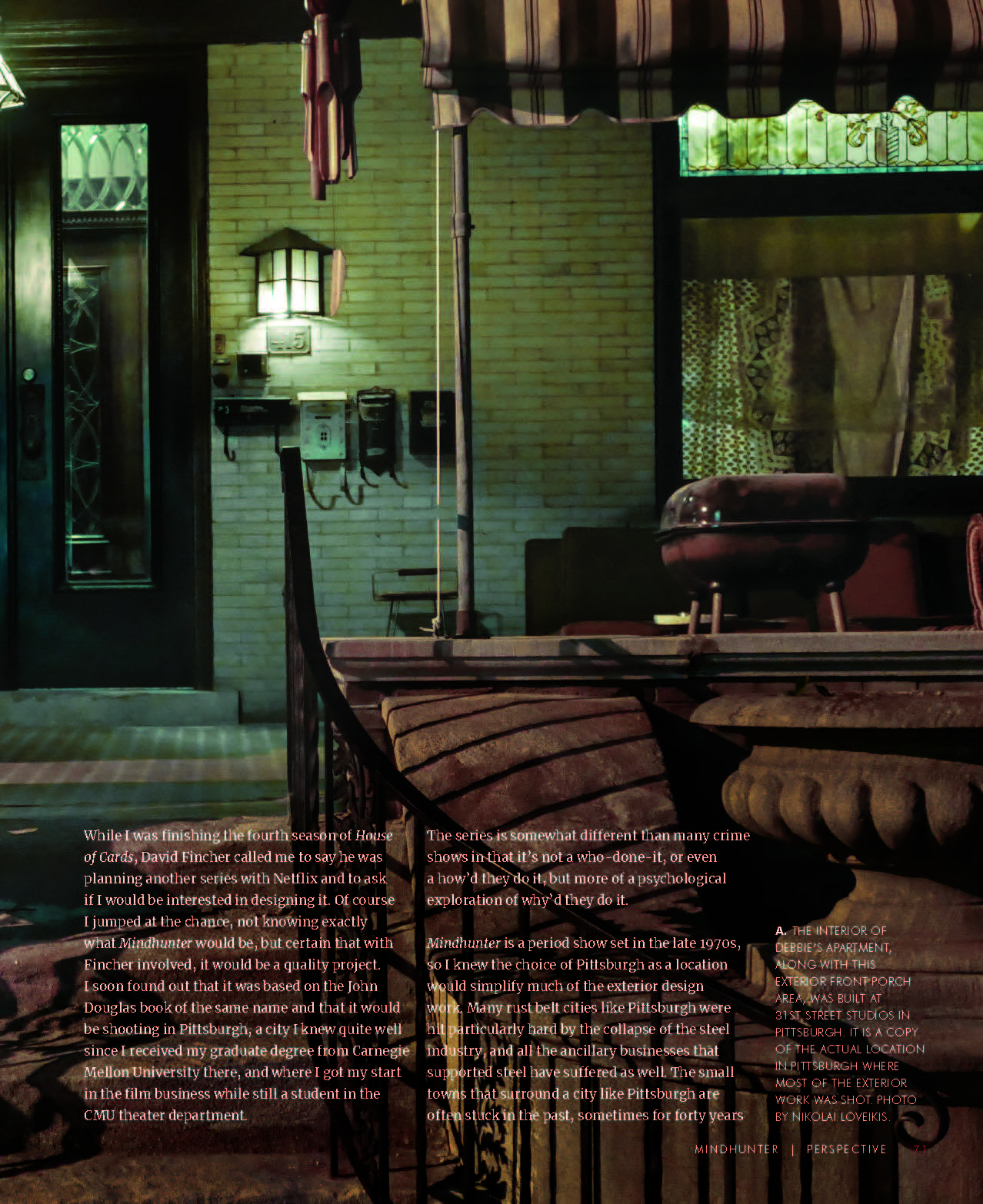
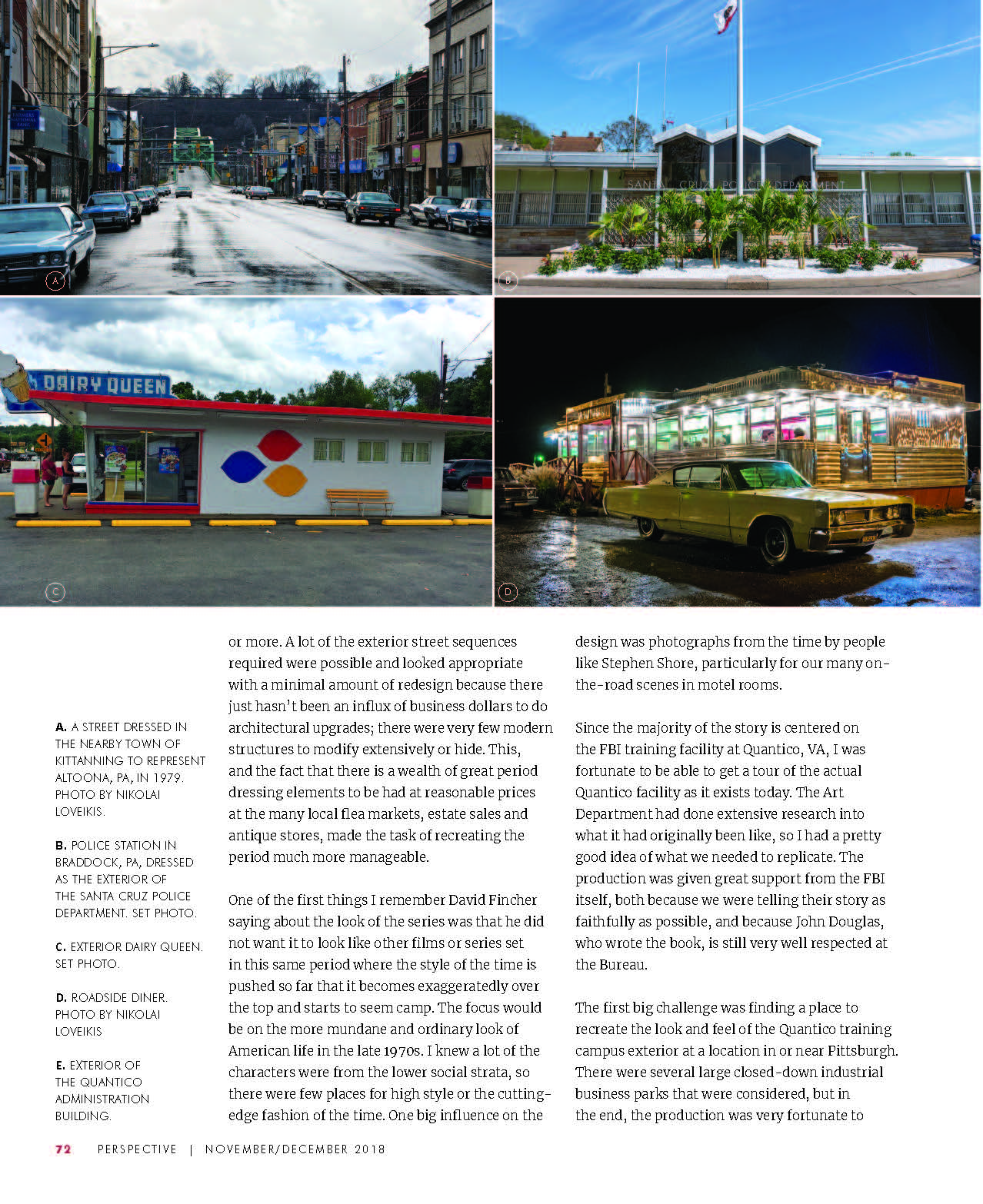
“Production designer Steve Arnold was familiar with the Pittsburgh area from attending Carnegie Mellon University. ‘Because the surrounding areas were hit very hard when the steel industry disappeared, a lot of these towns are caught in the past,’ Arnold explains. ‘Things haven't changed in 40 or 50 years there, so there's a sensibility and a look that hasn't really changed. We had to bring period cars in and remove a lot of things that were contemporary, but if you wanted the '70s, you just opened a door, and there it was.” - Liane Bonin Starr

Red Carpet Report Interview with Mindhunter Season 1 Creative Team
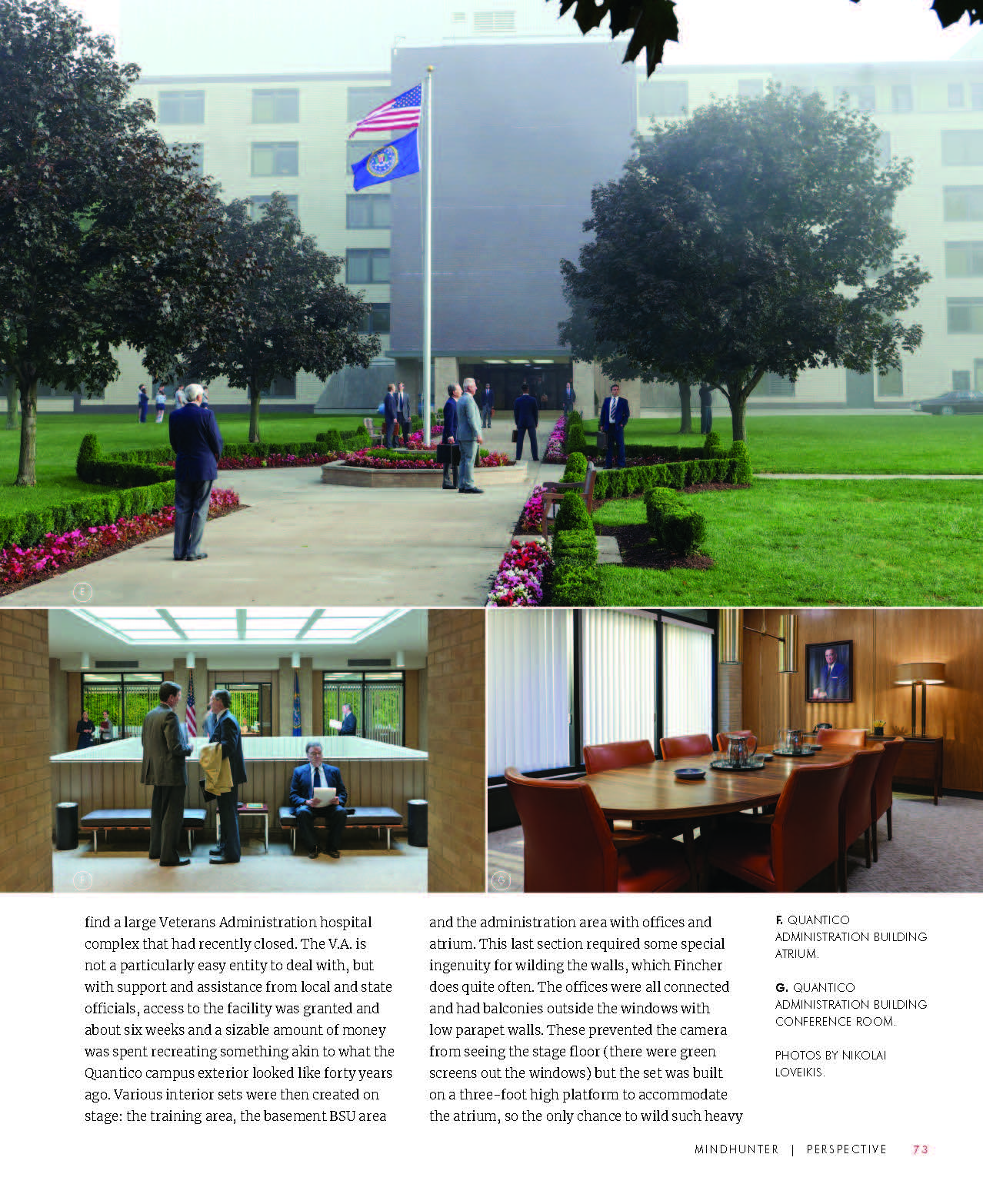
“With a story like this, it is important to embrace that which is mundane because the whole notion of these people, who are hunting other people, hiding in plain sight had to be believable that they could,” Fincher said … The production design was no different in terms of keeping it mundane and realistic to the 70s era at the FBI.” - Laura Sirikul

Filmmaker Magazine Interview with Mindhunter DP Erik Messerschmidt on Design and Cinematography
“For Jerry Brudos’s scenes [production designer] Steve Arnold built an amazing set inside a prison gymnasium – he designed a chain link cage inside the larger room of the gym.” - Matt Mulcahey

Interior’s Journal Interview for Mindhunter Season 1
“The television show, Mindhunter, created by Joe Penhall and executive produced and directed by David Fincher, is one of the most visually distinctive shows and for good reason. David Fincher's filmography has become something that we aren't used to seeing. From the Cinematography to the Production Design, Fincher has achieved a level of mastery that other films and television shows do not seem to have.” - Interior’s Journal 2017

Indie Wire Review - ‘Mindhunter’: The David Fincher Look is All About Power and Control
“And Fincher’s collaboration with production designer Steve Arnold (“House of Cards”) and gaffer-turned cinematographer Erik Messerschmidt (“Mad Men”) was crucial to the authentic ’70s look and dynamic blocking of the interrogation scenes, particularly those involving Ed Kemper (Cameron Britton), who captivates and mentors Holden.” - Bill Desowitz 2018

SET DECOR interview for Mindhunter Season 1
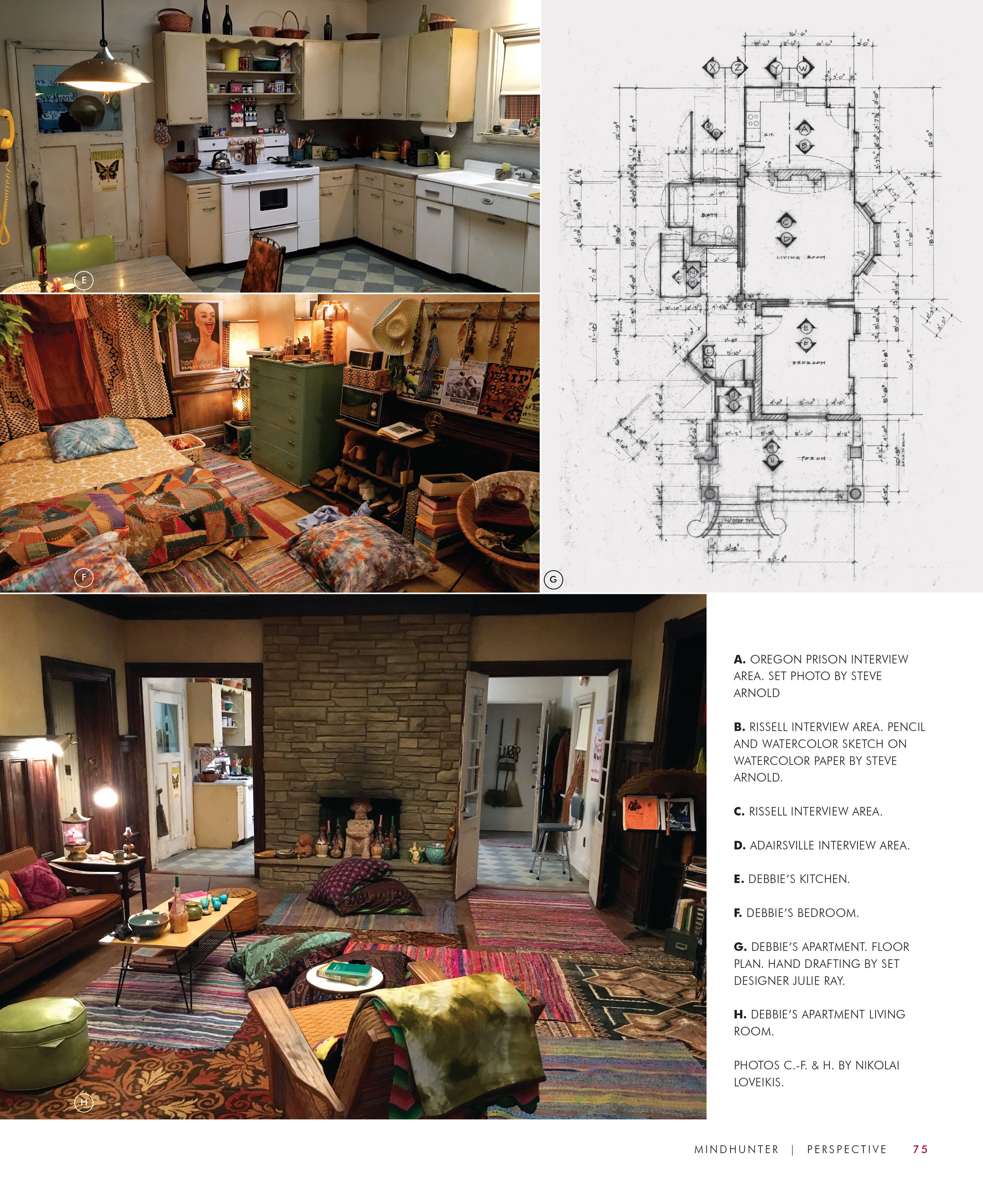
“Add in Production Designer Steve Arnold and Set Decorator Tracey Doyle SDSA, and you know it will have a carefully curated stylized realism mixed with fully realized layered reality. Sets that could be paintings, except they seem so real.” - SET DECOR 2017

Stitcher Podcast Interview for Castle Rock Season 1
“At the center of the town is Shawshank Prison; it’s Castle Rock’s main job source. With its ominous sensibility, its abandoned wing, its clanging cells, it is super forbidding” - Dave Holmes 2018

Mandy Interview for Castle Rock Season 1 “Steve Arnold Shares His Success Story”
“Steve Arnold is a three-time Emmy-nominated production designer known for hit TV shows Castle Rock, House of Cards (for which he won an Art Directors Guild award) and Mindhunter. Here he tells Mandy News how he started out, share details of his process and reveals what aspiring production designers can do to better themselves.” - James Collins 2018

Motion Picture Association Interview for House of Cards Season 4
“Arnold has created incredibly life-like representations of some of the most iconic interiors in America, including the Oval Office and the House of Representatives chamber floor, and he's done so with great ingenuity and, as the rigors of television production demands, at top speed.” - Bryan Abrams 2016

Pushing Pixels “Production Design of ‘House of Cards’ - interview with Steve Arnold”
“He talks about what sets “House of Cards” apart from the run-of-the-mill episodic TV shows … how lifting restrictions on episode length and removing commercial breaks affected the structure and delivery of the story … and his general thoughts on the collaboration between physical and digital over the last few decades.”

Architectural Digest: “Tour the High Drama Sets of ‘House of Cards” with Steve Arnold
“The fourth season sort of mirrors the election campaign that we’re involved in right now. It basically follows the national conventions and all the politicking that goes up to it,” says the show’s production designer, Steve Arnold, who creates the polished spaces (and sometimes seedy backrooms) where the political drama unfolds.” - Elizabeth Stamp 2016